Google Ads vs Meta Ads: Which Is Right for Your Business?
Google captures people who are already searching. Meta creates demand among people who are not searching yet. How to choose between them, when to use both, and how to split a first budget.

How to set up, test and scale Facebook and Instagram ads for an online store in the UAE — tracking, account structure, bilingual creative, offers and the numbers to watch.
Facebook and Instagram are still the fastest way for most UAE online stores to reach new customers at scale. They are also where many stores lose money: campaigns launched without reliable tracking, too many ad sets competing for the same people, and creative that never gets a fair test. This guide walks through the setup we use for e-commerce brands selling in the UAE, in the order we do it.
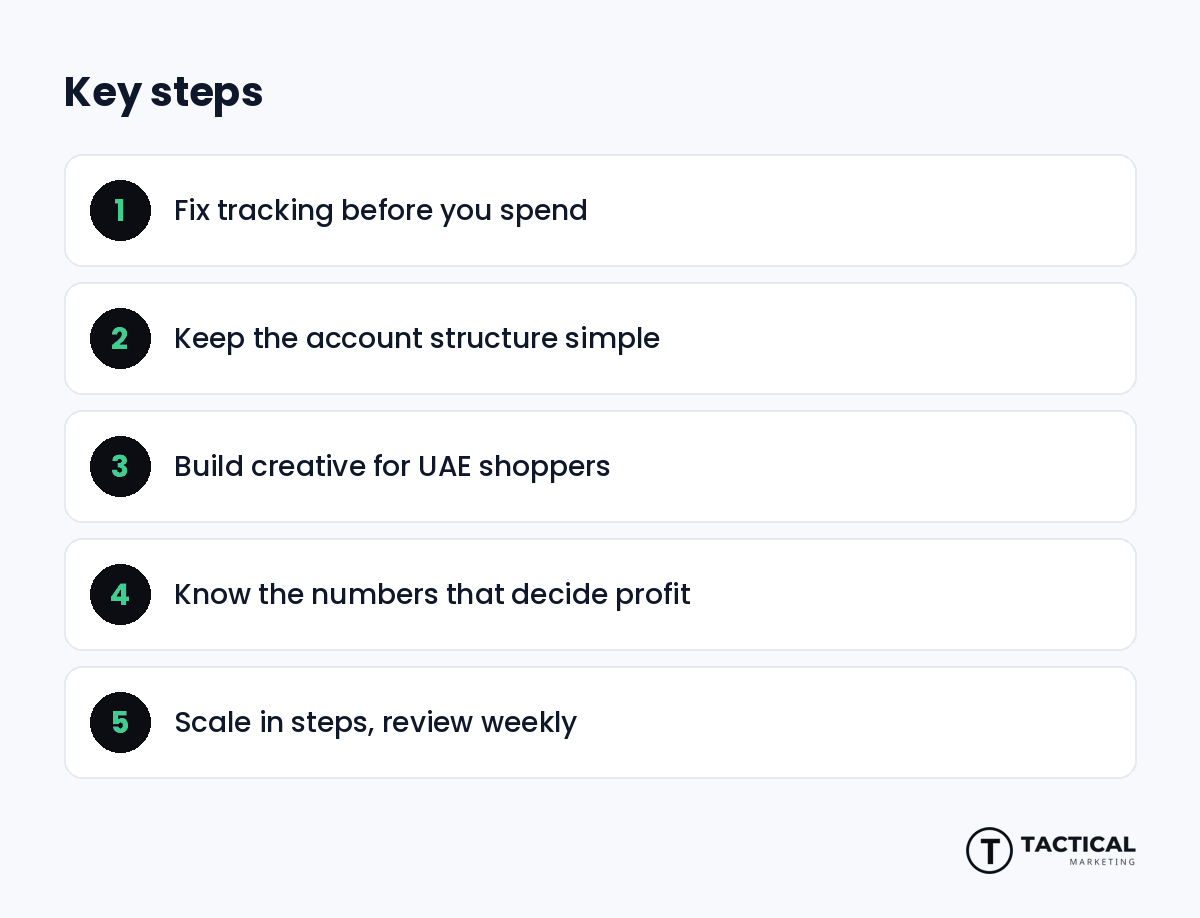
Meta’s delivery system optimizes toward the events you send it. If those events are missing or duplicated, the algorithm learns from noise.
If your store offers cash on delivery, decide what counts as a conversion. A COD order that is later refused is not revenue. Many stores send the purchase event at checkout but review delivered-order rates monthly, so they know the real cost per paying customer.
Most accounts we audit have too many campaigns. Each small ad set gets too little data to exit the learning phase, so costs stay high and results are hard to read. A three-part structure works for most stores:
Consolidate budgets rather than spreading them. One well-funded campaign usually beats five starved ones.
The UAE audience is multilingual and mobile-first. What works:
Test angles, not small variations. “Problem and solution”, “social proof”, “offer-led” and “founder story” are different angles. Changing a button colour is not a meaningful test.
Discounts work, but constant discounts train customers to wait. Use them around real moments: launches, Ramadan and Eid, White Friday, the Dubai Shopping Festival and back-to-school. Outside those periods, value-adds such as free delivery thresholds, bundles and gifts with purchase usually protect margin better than percentage discounts.
Before scaling, calculate your break-even ROAS: the return on ad spend at which a sale covers product cost, delivery, payment fees and ad cost. If your gross margin after those costs is 40%, break-even ROAS is 1 ÷ 0.40 = 2.5. Anything below that loses money on the first order.
Then track:
When an ad set or campaign is consistently above your target ROAS for a week or more, increase the budget gradually — around 20% every few days — and watch cost per purchase. Large overnight jumps often reset learning and push costs up. Scale horizontally too: bring winning creative into new campaigns and audiences instead of relying on one ad.
A simple rhythm keeps the account healthy:
Meta ads reward discipline more than tricks. Get tracking right, keep the structure simple and feed the account with new creative every month, and results become far more predictable.
Want a second opinion on your account? Our Meta advertising service covers tracking, structure and creative testing, and you can book a free 30-minute consultation to review your numbers with us.
Keep reading
Google captures people who are already searching. Meta creates demand among people who are not searching yet. How to choose between them, when to use both, and how to split a first budget.
A step-by-step guide to tracking leads and sales from Facebook and Instagram ads on a WordPress site: the Pixel, the Conversions API, deduplication, testing and the mistakes that break tracking.
Most ad budgets are lost after the click. A practical 15-point checklist for landing pages that turn paid traffic into enquiries: message match, speed, proof, forms, WhatsApp and tracking.