Google Ads vs Meta Ads: Which Is Right for Your Business?
Google captures people who are already searching. Meta creates demand among people who are not searching yet. How to choose between them, when to use both, and how to split a first budget.
“Should we advertise on Google or on Facebook and Instagram?” is one of the first questions business owners ask us. The honest answer is that they do different jobs. Once you understand the difference, the choice for your business usually becomes clear.
The core difference: intent versus attention
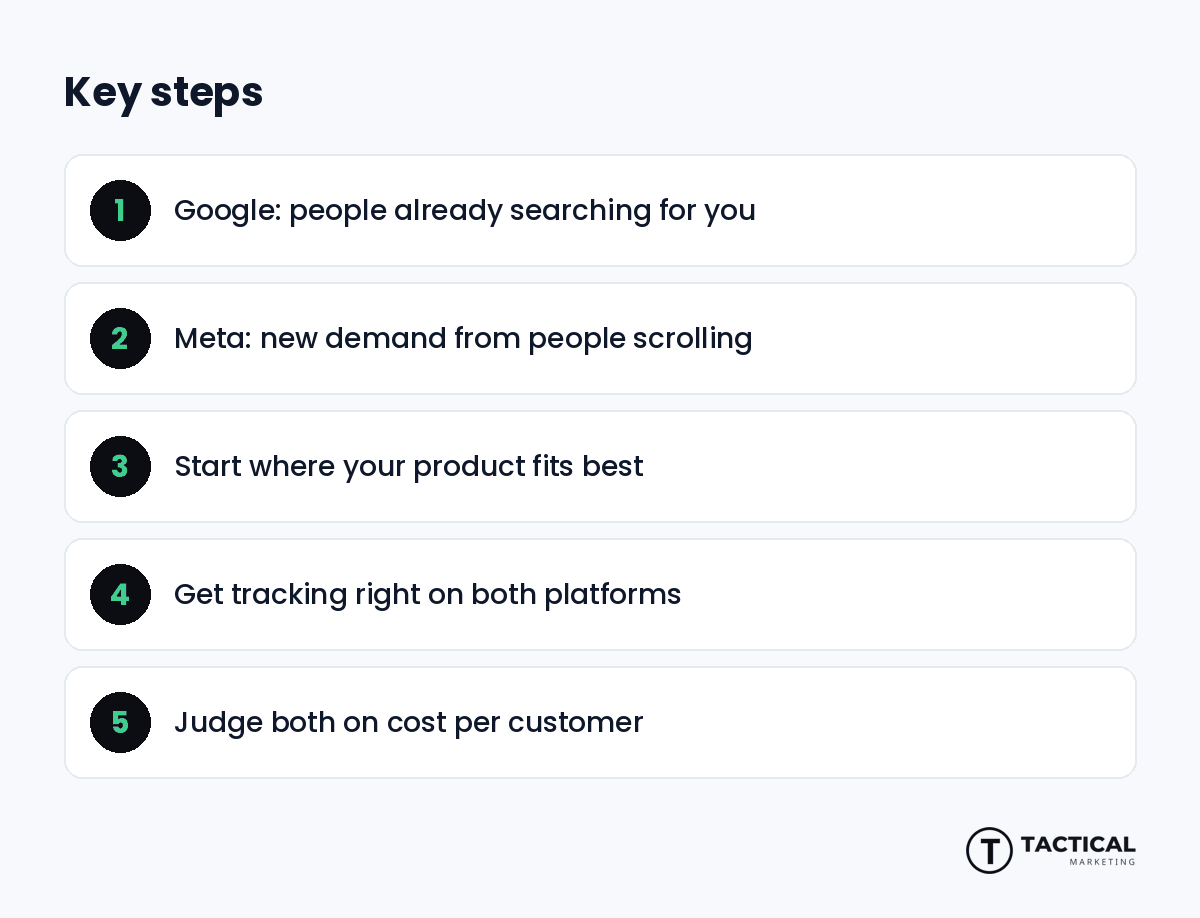
Google Ads shows your ad to people who are already searching for something: “dentist near me”, “buy office chairs online”, “accounting firm Dubai”. You are capturing demand that already exists.
Meta Ads (Facebook and Instagram) shows your ad to people based on who they are and how they behave, while they scroll. Most of them were not looking for you. You are creating demand by putting an offer in front of the right people.
That one difference explains most of what follows.
When Google Ads is usually the better first step
People actively search for what you sell, especially with urgency: repairs, clinics, legal or business setup services, B2B suppliers.
Each customer is worth a lot, so a higher cost per click still pays off.
You sell something people compare before buying and search for by name or category.
You have a clear landing page with a form, a call button and WhatsApp.
If nobody searches for your product yet because it is new or unusual, Google has little demand to capture.
When Meta Ads is usually the better first step
Your product is visual or easy to understand in a short video: fashion, beauty, food, home products, events.
People buy on impulse or discovery rather than after a search.
You are launching something new and need people to know it exists.
You have strong creative: photos, videos, user-generated content and clear offers.
Meta is also strong for retargeting: reminding people who visited your site or engaged with your content.
A side-by-side comparison
What the user is doing: searching on Google; scrolling on Meta.
Best for: high-intent services and considered purchases on Google; visual products, launches and impulse buys on Meta.
What drives results: keywords, landing pages and bids on Google; creative, offer and audience signals on Meta.
Typical cost pattern: higher cost per click but higher intent on Google; cheaper reach but more people who need convincing on Meta.
Creative needs: text ads and a strong landing page for Google; a steady flow of images and videos for Meta.
Why many businesses end up using both
The two platforms support each other. Meta introduces people to your brand. Some of them later search for you or your category on Google, where search ads catch them. Retargeting on both brings back visitors who did not buy the first time.
A practical order for most businesses:
Start with the platform that fits your product best, using a test budget.
Get tracking right: GA4 key events, the Meta Pixel with the Conversions API, and Google Ads conversions.
Once one channel is profitable, add the second to grow, not to rescue the first.
How to split a first test budget
There is no universal split, but a simple rule works for many businesses: put most of the first budget (for example around two thirds) into the platform that fits your business best, and the rest into the other as a controlled test. Run it long enough to collect real data, often four to eight weeks, then move money towards what produces customers at a cost you can afford.
Judge both platforms on the same number: cost per qualified lead or cost per sale, measured in your CRM or store, not just in the ad platform.
Common mistakes
Choosing a platform because a competitor uses it, without checking whether your customers behave the same way.
Running Meta ads with weak creative and blaming the platform.
Running Google ads to a homepage instead of a page built for that search.
Comparing platforms on clicks or reach instead of cost per customer.
Turning a campaign off after a few days before it has enough data.
Frequently asked questions
Which is cheaper, Google Ads or Meta Ads? Meta often has cheaper clicks and reach, while Google clicks often cost more but come from people with stronger intent. The useful comparison is cost per customer, not cost per click.
Can a small business start with both? Yes, if the budget allows each platform enough data to learn. With a small budget, start with one and add the second later.
Do I need a website for Meta Ads? Not always. Meta can send people to WhatsApp, Messenger or instant forms. But a fast landing page usually gives you better tracking and better-qualified leads.
Not sure where to start? Book a free 30-minute consultation and we will look at your product, market and budget and tell you which platform we would test first.
A step-by-step guide to tracking leads and sales from Facebook and Instagram ads on a WordPress site: the Pixel, the Conversions API, deduplication, testing and the mistakes that break tracking.
How to set up, test and scale Facebook and Instagram ads for an online store in the UAE — tracking, account structure, bilingual creative, offers and the numbers to watch.
More leads are easy. Better leads are hard. A practical framework for developers and brokerages using Meta, Google, landing pages and WhatsApp to generate enquiries that turn into viewings and deals.